Project-Based Learning: innovation in the classroom

With the arrival of information and communication technologies in schools, both new teaching methodologies and new versions of existing methodologies, now revised for digital generations, have emerged. Project-based learning (PBL), which we review today, is one of them.
In its essence, PBL allows students to acquire key knowledge and skills through the development of projects that respond to real-life problems.
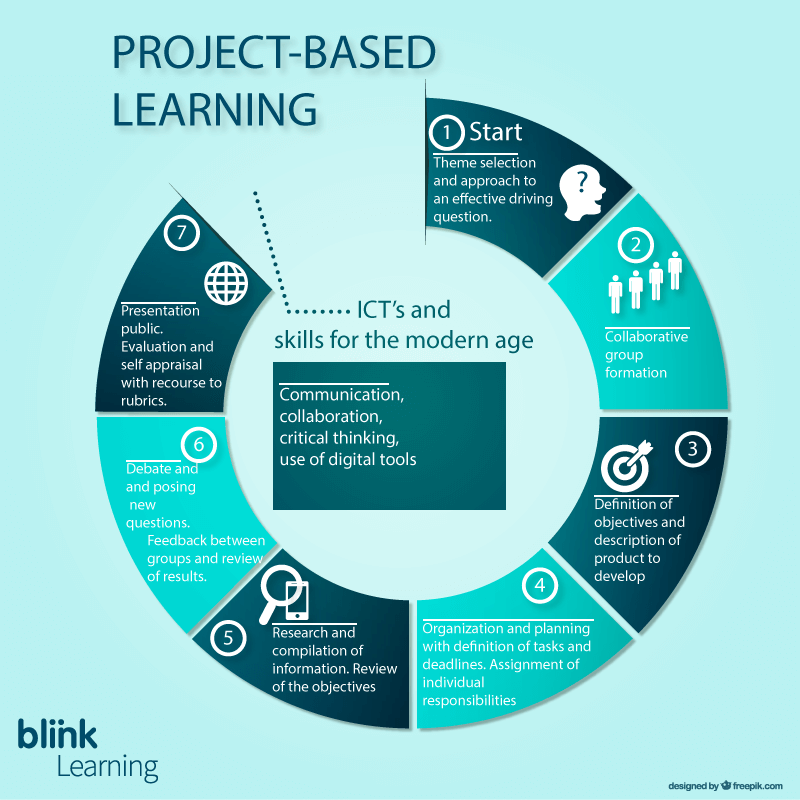
The objective is to enhance their autonomy and become the protagonist of their own learning process. Each group of students must plan, structure, execute and present the product that should answer the chosen guide question (see infographic below). For his part, the teacher has the responsibility to guide and support the students throughout the entire project.
 De acuerdo con el Instituto de Tecnologías Educativas y Formación del Profesorado (INTEF) del Ministerio de Educación, Cultura y Deporte:
 Nearly 10 years later, project-based learning has not developed in line with expectations. In this, as in other cases of innovative methodologies, there were important challenges in its implementation – at the technological level (at that time there were few centers with the necessary infrastructure to do it properly) and also at the level of teacher training.
In Spain, it is now beginning to bet more decisively on these models, partly because schools are more prepared to launch projects of this type.
See also
In its simplest version, we should start by trying empathy. That is, asking students what they consider important and provokes their curiosity, how they prefer to focus it and what tools and platforms they would prefer to use. With this information, it would be possible to define a model that fits the curricular objectives, test it in a classroom environment and, finally, put into practice. This dynamic means that innovation in class depends not only on students capable of solving problems, but on generating new unknowns that they will have to solve during the learning process. Instead of forcing students to adapt to curricula, the opposite is attempted.
De acuerdo con el Instituto de Tecnologías Educativas y Formación del Profesorado (INTEF) del Ministerio de Educación, Cultura y Deporte:
“PBL today represents the best didactic guarantee for an effective contribution to the development of students’ key competencies”.
Better prepared for the `real´ world
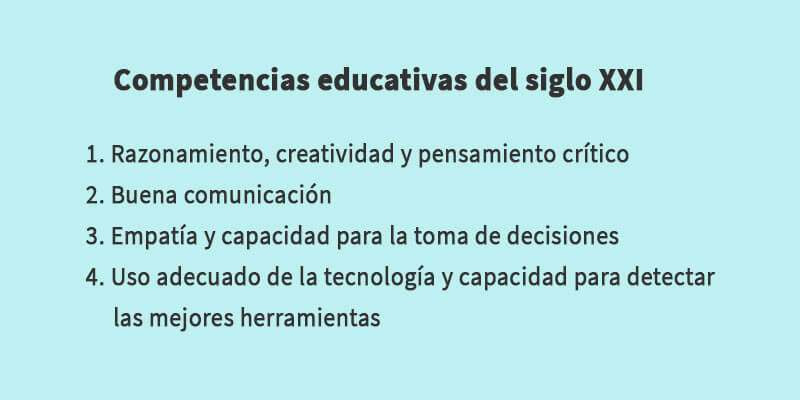
It is a methodology that is expanding in schools and has significant benefits for students and teachers. Starting from a concrete and real-life problem, instead of the traditional theoretical and abstract model, the improvements in the ability to retain knowledge by students, as well as the opportunity to develop complex skills such as critical thinking, communication, collaboration seem obvious or problem solving. These are some of the skills called by experts as “21st Century Competencies”, which seem important to ensure a successful academic or professional career. An article published in 2007 in Edutopia.org brought up the need to change paradigms, and highlighted the ABP as one of the great future trends of digital education.“The old model of learning facts passively and then reciting them out of context is no longer enough to prepare students in today’s world. Solving complex problems involves fundamental skills (reading, writing, math) along with other 21st century competencies such as teamwork, time management and the use of digital tools”.
Nearly 10 years later, project-based learning has not developed in line with expectations. In this, as in other cases of innovative methodologies, there were important challenges in its implementation – at the technological level (at that time there were few centers with the necessary infrastructure to do it properly) and also at the level of teacher training.
In Spain, it is now beginning to bet more decisively on these models, partly because schools are more prepared to launch projects of this type.
Bridging with Design Thinking
En Edutopia.org se trataba de nuevo este tema a través de artículo firmado por Beth Holland, docente e investigadora educativa. Tras hablar con otros docentes, esta profesora concluyó que en los proyectos de innovación implementados en colegios faltaban con frecuencia elementos fundamentales. Si, por un lado, los centros eran exitosos en desarrollar un entorno y una infraestructura, por otro tenían algunas dificultades en producir cambios de comportamientos y creencias de profesores, directivos y alumnos. En otras palabras, los profesores no tenían directrices claras sobre cómo aplicar el aprendizaje basado en proyectos al currículo existente, y los alumnos tampoco se sentían motivados para hacerlo. En este marco es donde el Design Thinking (metodología que centra su eficacia en entender y dar solución a las necesidades reales de los usuarios) puede hacer de puente entre el ABP y las partes interesadas.See also
Design Thinking: what it is and how to integrate it in your classroom
In its simplest version, we should start by trying empathy. That is, asking students what they consider important and provokes their curiosity, how they prefer to focus it and what tools and platforms they would prefer to use. With this information, it would be possible to define a model that fits the curricular objectives, test it in a classroom environment and, finally, put into practice. This dynamic means that innovation in class depends not only on students capable of solving problems, but on generating new unknowns that they will have to solve during the learning process. Instead of forcing students to adapt to curricula, the opposite is attempted.