8 methodologies that every 21st century teacher should know

New teaching methodologies are changing the educational environments around the world and driving better academic performance among students. We go over some of the main innovative approaches that educators have forged over the last few years and that every 21st century teacher should be acquainted with.
 This trend was consolidated with the increasing inclusion of gamification in school curricula and it is estimated that this inclusion will continue to grow in the future.
Flipped Classroom
One of the modern methodologies that has gained more popularity in recent years, Flipped Classroom is a pedagogical approach in which the traditional elements of the lesson taught by the teacher are reversed – the primary educational materials are studied by the students at home and, then, worked on in the classroom. The main objective of this methodology is to optimize time in class by dedicating it, for example, to meet the special needs of each individual student, develop cooperative projects or work on specific tasks.Project-Based Learning
With the arrival of new information and communication technologies to schools, both new teaching methodologies as well as new versions of existing methodologies, now revised and updated for the digital generation, have emerged. One of the most used in class at present is Project-Based Learning (PBL). In its essence, PBL allows students to acquire key knowledge and skills through the development of projects that respond to real-life problems.The teaching based on projects or integrated tasks, is today the best didactic guarantee for an effective development of key skills while also acquiring the knowledge of the curriculum’s content.Starting from a concrete problem, instead of the traditional theoretical and abstract model, sees notable improvements in students’ ability to retain knowledge as well as the opportunity to develop complex competencies such as critical thinking, communication, collaboration or the problem solving.
Cooperative Learning
“Stronger together”. This concept in a simple way cooperative learning, a methodology that teachers use to group students together and, thus, impact on learning in a positive way. The proponents of this model theorize that working in a group improves the attention, involvement and acquisition of knowledge by students.The main characteristic is that it is structured based on the formation of groups of 3-6 people, where each member has a specific role and to reach the objectives it is necessary to interact and work in a coordinated manner. In a cooperative learning context, the final goal is always common and will be achieved if each of the members successfully performs their tasks. On the other hand, individual learning has students focusing on achieving their objectives without having to depend on the rest of their classmates.The final goal is always group-oriented and will be achieved if each of the members successfully perform their tasks.
Gamification
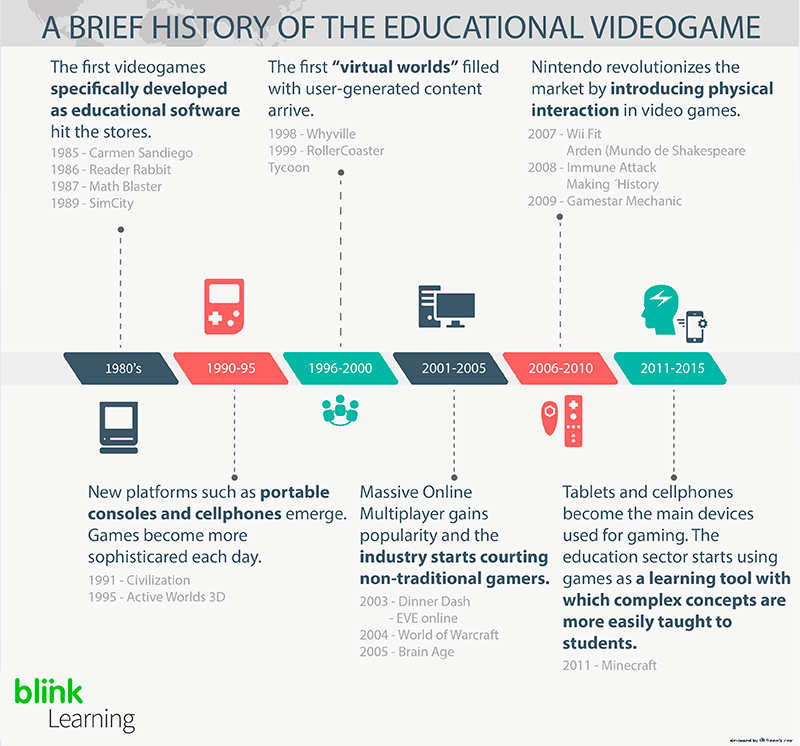
The integration of game mechanics and dynamics in non-ludic environments, or gamification, has been practiced for a long time. Over the past few years, however, and particularly due to the evolution of videogames, the phenomenon has gathered unprecedented dimension, and is one of the most talked about as a current and future trend of the EdTech industry. Since, in the 80’s, games with an international vocation such as the “Carmen Sandiego” series or “Reader Rabbit” (see infographic below) have gained worldwide popularity, the development of educational titles has increased consistently. Not only those aimed at the general public but, ever more often, those specifically designed for students and particular courses.
This trend was consolidated with the increasing inclusion of gamification in school curricula and it is estimated that this inclusion will continue to grow in the future.
You might also like
4th Survey on the Use of Technology in Education
Problem-Based Learning
Problem-Based Learning (PBL) is a cyclic learning process composed of many different stages, starting with asking questions and acquiring knowledge that, in turn, leads to more questions in a growing complexity cycle. Putting this methodology into practice does not only mean the exercise of inquiry by students, but convert it into useful data and information. According to several educators, the four great advantages observed with the use of this methodology are:- The development of critical thinking and creative skills
- The improvement of problem solving abilities
- Increased student motivation
- Better knowledge sharing in challenging situations
Design Thinking
Education has always been a prolific space for innovation. Teachers all over the world are constantly coming up with new ideas and methodologies to introduce in the classroom making the best of the tools at their disposal. Design Thinking (DT) applied stems from industrial designers and their unique method to solve problems and satisfy the needs of their clients. Applied to education, this model makes possible to identify with greater accuracy the individual problems of each student and generate in their educational experience the creation and innovation towards the satisfaction of others, which then becomes symbiotic.Thinking-Based Learning
Beyond the debate around the effectiveness of learning by memorizing facts and data when discussing education, one of the most talked about aspects is the need to show students how to work with the information they receive at school. Teach them to contextualize, analyze, relate, argue… In short, convert information into knowledge. This is the goal of Thinking-Based Learning (TBL), developing thinking skills beyond memorization and, in doing so, developing effective thinking on part of the students.Competency-Based Learning
By definition, all learning methodologies have the acquisition of knowledge, the development of skills and the establishment of work habits as their main goals. Competency-Based Learning (CBL) represents a set of strategies to achieve this. Through assessment tools such as rubrics, teachers can go through the academic curriculum without significant deviations but focusing it in a different way, putting into practice real examples and, thus, transmitting to their students a more tangible dimension of the lessons.Photo: VFS Digital Design