
Design Thinking: what it is and how to integrate it in your classroom

An instant hit among teachers
While still a relatively recent methodology, several successful cases have been attributed to the use of DT in the classroom. The focus on brainstorming, group work and respect for the ideas of colleagues has produced very positive academic results that have led teachers to use it progressively, especially as a complement to other modern methodologies and resorting to technology in Classroom.As the movement of the DT in education broadens and deepens, many teachers are flexibly customizing the process in their own contexts. We are still talking about pilot projects in no more than a few thousand schools worldwide, but everything indicates that the methodology will soon be extended until it is definitively established in the teachers’ toolbox.Design Thinking, and the symbiosis that this model generates, allows to identify with greater accuracy the individual problems of each student and to generate in their educational experience the creation and innovation towards the satisfaction of others.
The model in 5 easy steps
1. Leadership with empathy
Empathy is the first step and the root of the DT. Leading with empathy is based on the classic definition of “walking in the shoes of others” to get us out of our own heads and thus understand the implicit needs of others and the circumstances in which we work. Empathetic leadership means pushing to get closer to people, and doing it consistently, publicly and with conviction. The key: listen more; speak less. Understand how is the experience of others in the environment where we are. Adopt the mind of a beginner and use all the senses to perceive what is happening around us.2. Define problems and challenge traditional assumptions
When facing a problem, the opportunity should be seized to do it better and in a more efficient way from the analytical point of view than has been done before. Useful phrases in this phase of the process are “What happens if …?”, Or “How could we …?”. The simple act of introducing the language of possibility can initiate the change of how we contemplate a problem. This definition exercise is fundamental to drive innovation, but it is also a way of moving from a deficit point of view to an asset approach. The key here is to develop the ability to discern the essentials of the accessory; execute policies and practices, individually and collectively, more effective by the fact of being willing to see things differently.3. Design experiments with real consequences
In this phase, the great challenges begin. “Just do it” is more than a commercial slogan. It means trying something and learning from it. We can become entangled in all kinds of knots about accepting an eventual failure, but what really matters is to try it, to do it publicly and thus generate opportunities for feedback. A failure is not necessarily a failure but a learning opportunity.4. Prototype, the concretization of the ideas raised
Defined the problems and conceived possible answers to solve them, it is time to put them into practice. The prototype phase involves building, testing and iterating. The expectation is that the students get conjugated exercises of explosion and narrowing towards more complex models, based on feedback and feedback in order to respond to the needs of users.5. Draw conclusions and check results
This is the iterative phase that allows students to analyze and reflect on the results obtained and thus evaluate the entire learning process. Group work is especially important in this step since it is the positive criticism of the colleagues that allows correcting errors and proposing alternative solutions. Encouraging students to make visual presentations of their findings is useful.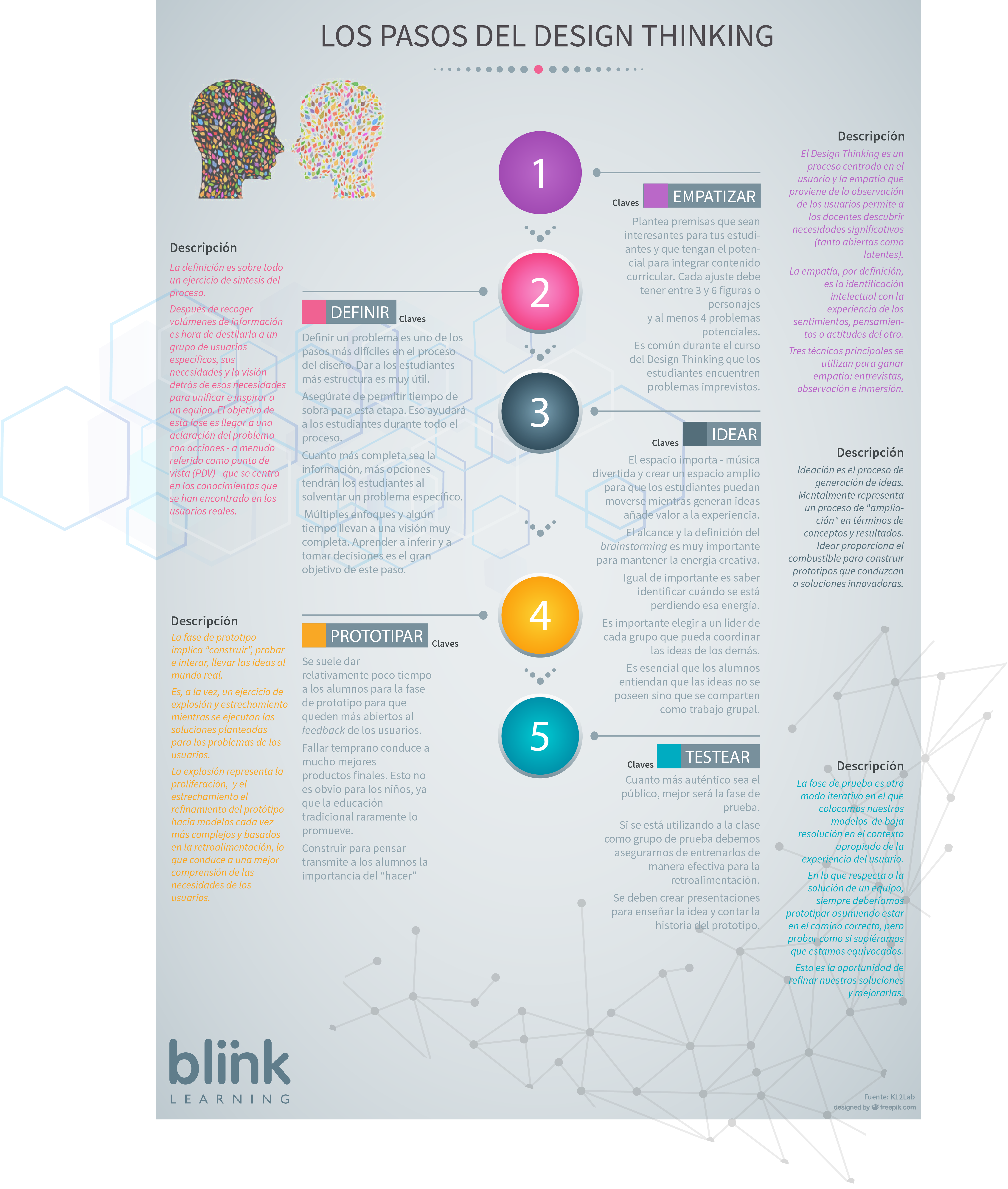
Detractors
Although many teachers are increasingly adopting the DT in their classrooms, there are also several experts and education stakeholders who do not share that hobby. Debbie Morrison, a well-known American pedagogue, recently wrote in Online Learning Insights:“I am not convinced that design thinking is applicable to all sectors, as we are led to believe, especially in education.” Thinking design requires a wide range of knowledge and experience from various disciplines, which is not present in the most non-university students given the stage of their cognitive development and education background”.
Morrison adds that DT requires that one “think of a problem from unconventional, even improbable perspectives, that leads to a collection of insights that will eventually produce a unique solution.” I suggest that teaching this process to elementary and secondary students is not only unfeasible but rather unnecessary and limiting, instead of spending time teaching a structured process of problem solving, it would be better to focus on other disciplines and methodologies. ” Irving Wladawsky-Berger, a professor at Imperial College London, is another prominent critic of the methodology. In an article published by the Wall Street Journal last November, the teacher argues that the DT can disperse the focus of the students.“Historically, learning to think critically – like asking questions imaginatively and considering multiple perspectives – has been associated with a liberal arts education, not with a business curriculum. [The methodology] represents a tectonic shift for educators and often leads the students made an artistic and liberal context”.
Irving Wladawsky-Berger
However, the author recognizes that DT can also promote “multidisciplinary approaches, an understanding of the global and historical context and generate good leadership skills”.
A useful tool
Regardless of the individual opinions of educational experts, the application of the DT to education is another tool available to teachers to conduct their classes. When developing a mentality towards the solution of problems, constantly analyzing the different variables; promote cooperation and respect for the opinions of others; and to identify the leadership characteristics of each student, Design Thinking is gaining ground among the new educational methodologies.Further reading
- http://mba.americaeconomia.com/articulos/notas/el-exito-de-tu-estrategia-de-design-thinking-depende-de-estos-7-factores
- http://fortune.com/2016/11/01/data-sheet-tom-siebel-design-thinking/
- https://www.edutopia.org/blog/design-thinking-empathy-challenge-discovery-sharing-susie-wise
- https://onlinelearninginsights.wordpress.com/2013/08/06/why-design-thinking-doesnt-work-in-education/https://onlinelearninginsights.wordpress.com/2013/08/06/why-design-thinking-doesnt-work-in-education/
- https://dschool.stanford.edu/sandbox/groups/k12/wiki/14340/attachments/e55cd/teacher%20takeaway.pdf?sessionID=b11a8db42ec775eccce2d52685da316b056ca0db
- http://designthinking.es/inicio/index.php
- http://www.huffingtonpost.com/ken-carbone/make-democracy-great-agai_b_12816102.html
- http://www.designthinkingforeducators.com/
- http://noticias.universia.es/educacion/noticia/2016/11/28/1146889/ventajas-design-thinking-educacion.html
- http://blogs.wsj.com/cio/2016/11/04/is-design-thinking-the-new-liberal-arts/
Photo: Thomasb – postitartists.com