
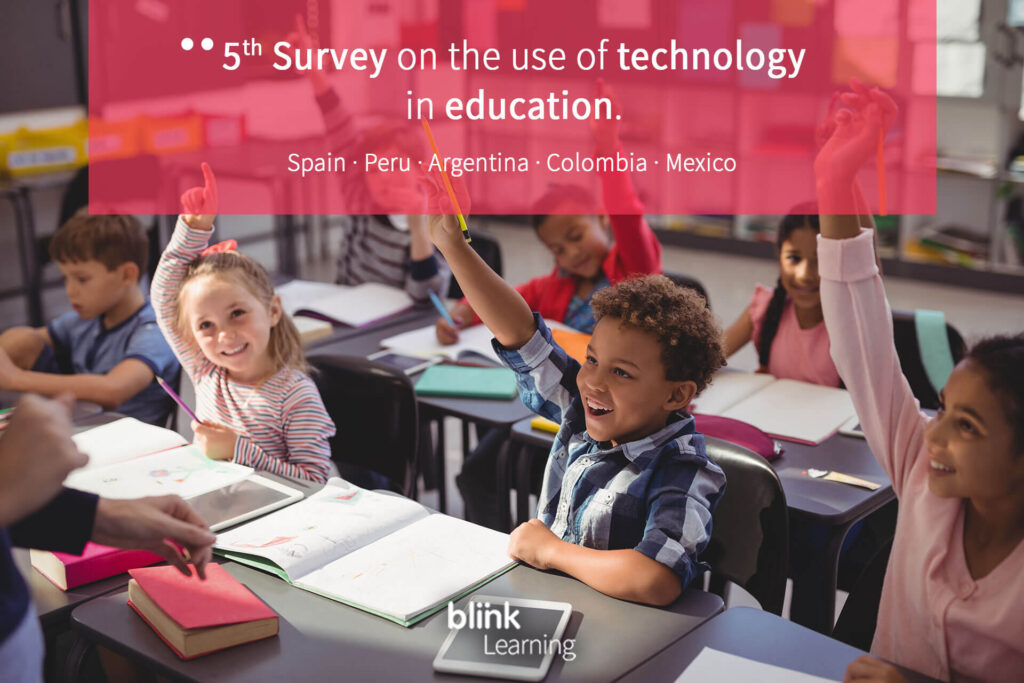
5th Survey on the use of technology in education
ACCESS THE REPORT HERE
For the fifth consecutive year, BlinkLearning presents the Annual Survey on the use of Technology in Education. Throughout this half decade, both the sample size and the number of participating countries have increased substantially.
This year, Argentina joins Spain, Mexico, Colombia and Peru in a total of 3,268 teachers surveyed, covering all types of schools and educational levels.
The role of technology in education, the teaching profession, student learning and an overview of the state of education from the educators’ perspective are the main topics addressed in this survey.
In addition, this year the survey was conducted within the global schools’ quarantine measures to stop the expansion of the Coronavirus, which has compelled all educational institutions (schools, academies, universities, vocacional training facilities, etc.) to adopt virtual classes.
For this reason, the importance of the report serves as a comprehensive analysis of the switch to digital learning in educational institutions of the countries surveyed as they turn mainly to online classes.
What was the use of technology in the classrooms before Covid-19? How prepared were schools and teachers to have to make this leap to digital transformation in such a short time? These are some of the questions that arise these days. Here are some conclusions from our survey.
The main advantages in implementing a digital project in the school
- More than 65% of teachers in the five countries surveyed consider that the use of technology motivates students.
- Educators from Spain, Argentina, Colombia, Mexico and Peru agree that the main advantage of the use of ICTs in classrooms is being able to access a greater number of content and resources online.
- 40% of teachers consider that the use of technology encourages autonomous learning. Also, it helps students learn to communicate using different languages or other means of expression.
- Most teachers in the countries surveyed stated that they would recommend a colleague to start a digital project at their school.
The biggest challenges facing education in this day and age
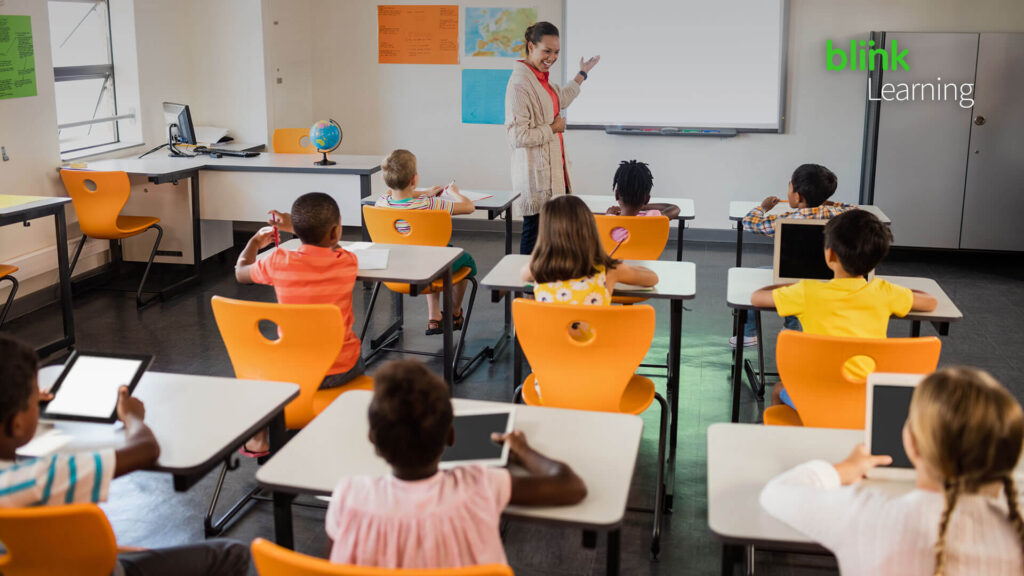
- In Argentina, Mexico and Peru, teacher training is the main challenge for education development at a general level. In Colombia the most important issue is the improvement of the working conditions of teachers. And in Spain, it is achieving greater student motivation.
- The greatest challenges regarding the implementation of technology into the classroom are shared by all, to a greater or lesser extent, in the five countries surveyed. The consensus appears to be around the lack of teacher training and connectivity problems. Insufficient devices for students and faculty members is another recurring issue mentioned.
- As for students, the main deficit identified in ICT use is the difficulty they have in selecting reliable sources of information. And the need for more creativity to extract the maximum potential from these technological tools.
- In Spain and Peru there is a concern about data protection and the inability to perceive the risks to which students and teachers are exposed when working online.
The teacher’s role today
- About 90% of Spanish and Latin American teachers think that their profession is not sufficiently valued by society.
- However, more than 40% of Latin American teachers stated that they love their work and feel motivated.
- 50% of Spanish teachers believe that awareness campaigns help improve the perception of the teaching profession in society.
- The educational community of these five countries agree that the best practice to improve the training of new teachers is through more courses and specialization training.
- For all five countries surveyed cooperative/collaborative learning is the most used active methodology in classrooms with a percentage of around 75%, while Visual thinking and Design thinking are the least implemented with around than 10%.
Students and ICTs
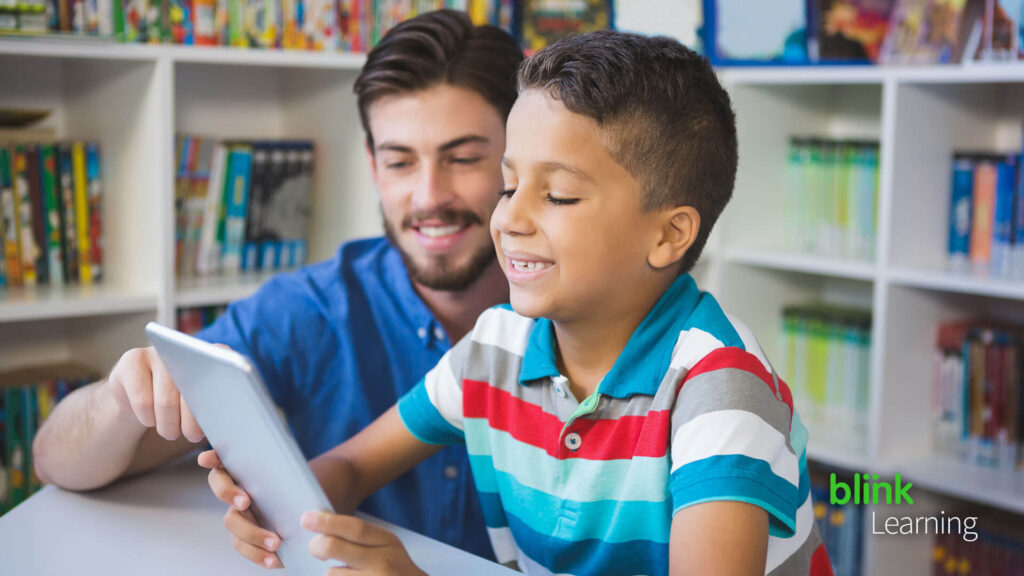
- Mobile phones is the undisputed protagonist in classrooms, being the most used device by students. Colombia is the country with the highest use of mobile phones (66%), followed by Argentina (61%), Mexico (49%), Peru (44%) and Spain (29%).
- For teachers in Spain, Colombia and Mexico, the main change in the interests of students is due to the fact that they are highly influenced by social networks. In Argentina and Peru, respondents consider the students spend more time alone so they depend more on new technologies.
- Everything related to technology, be it with their peers or other aspects of their real life, is the one thing that most interests students according to teachers.
The 5th Survey on the use of Technology in Education has been made possible thanks to an entire team of education experts who have helped us in sharing the questionnaire and including the most relevant issues for the teaching community.
We would like to acknowledge their contribution. Specifically, Corporación Universitaria Uniminuto de Dios and Ministerio de Educación Nacional de Colombia, both from Colombia. Observatorio de Innovación Educativa del TEC de Monterrey from Mexico, Universidad Rey Juan Carlos from Spain, Argentina’s Dinamo Labs, the Municipalidad de Lima from Peru and the comunidad educativa EdTech Peru.
Access the 5th Survey on the use of Technology in Education:
For further information contact:
Esther Antón
Head of Communication and Marketing
T +91 725 61 28
esther.anton@blinklearning.com