Skip to content
  • Blog de BlinkLearning
  • Blog de BlinkLearning
  • Blog de BlinkLearning
  • Blog de BlinkLearning

Search the blog

Main sections of the blog

  • AI
  • Schools
  • Publishers
  • Responsible technology
  • AI
  • Schools
  • Publishers
  • Responsible technology
  • EN
    • ES
    • BR
Schools

Toni García’s perfect teaching methodology
19 de March de 2019 BlinkLearning Comunicación No comments yet
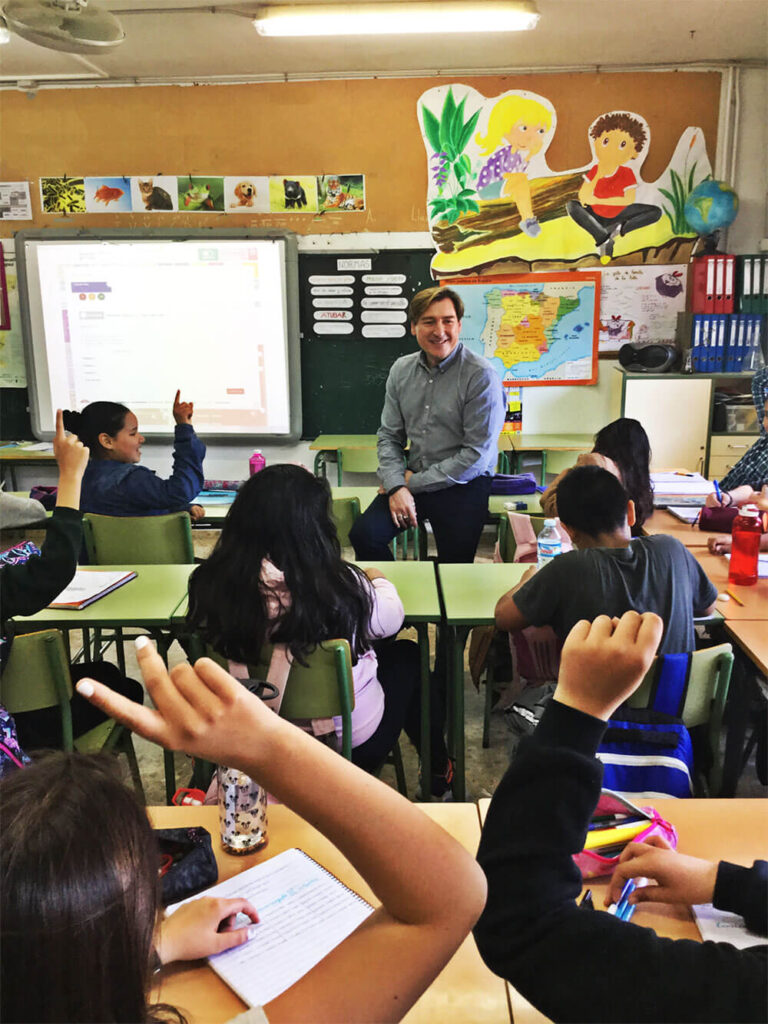
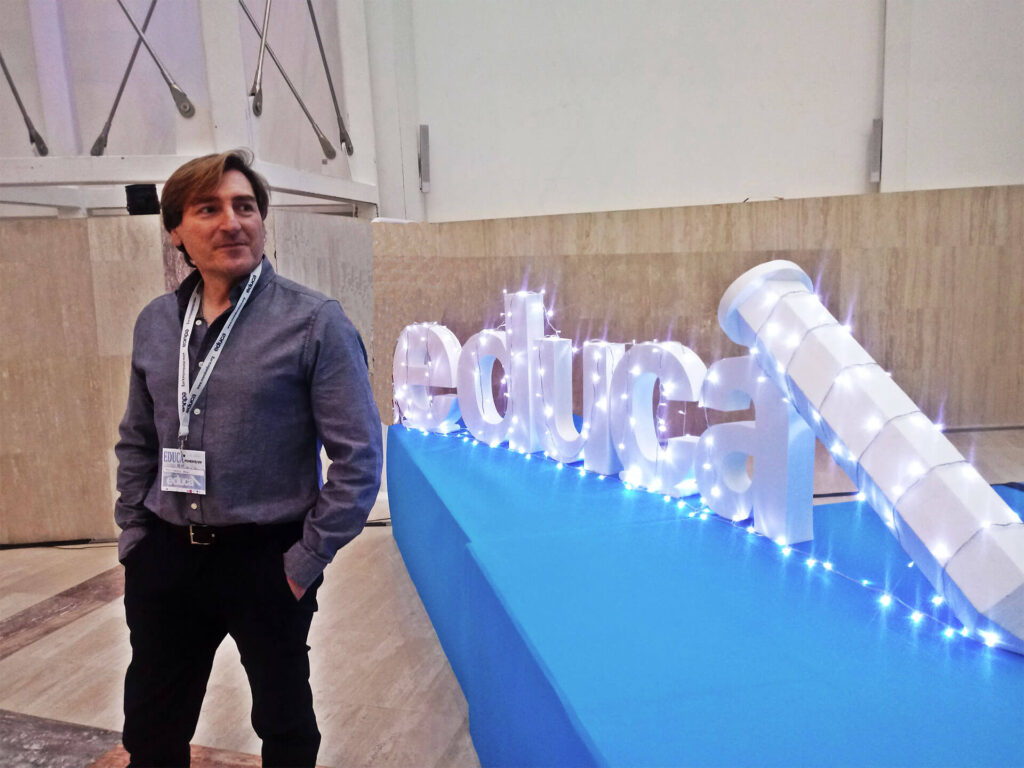
For me there is no perfect teaching methodology and this is something that all teachers must understand from the start. Each of our students has their own learning characteristics that make them feel more comfortable with one type of methodology than with another. Thus, while more dynamic and pragmatic students are comfortable with active methodologies, the more introverted and analytical ones tend to handle those which more behavioral better. Therefore, in my daily teaching activity, I favor varying methodologies, so that all children have the same opportunities to develop their individual potential. These are some of the teaching methodology that I use the most in my classes:
  • Cooperative learning: It is about organizing small groups in which students work together in a coordinated way to solve a specific task.
  • Collaborative learning: Very similar to the previous one. While in the cooperative the teacher is the one who poses the problem, organizes the groups and distributes roles, in collaborative learning the group is in charge of organizing this whole structure.
  • Project-based learning: It’s my favorite. It is a set of individual and / or group tasks that involves the student in the design and planning of learning, in decision-making and in research processes, having to work autonomously for most of the time. It culminates with the realization of a final product, which must be presented to others.
  • Research-based learning: Very similar to the previous one, but based on the use of scientific methods.
  • Gamification: It is the integration of game dynamics adapted to the classroom in non-ludic environments. For gamification, I usually use badges.

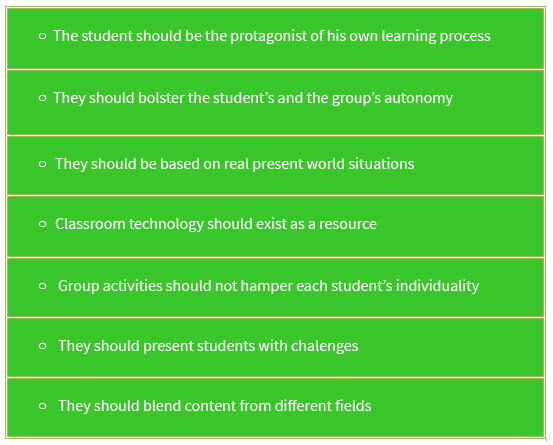
So, what should we consider when we design our teaching projects?

Basically, the following elements:

My current projects

As a Year 7 teacher I am constantly involved in several projects with my students. These are some of the latest we developed together:
  • Creation of a restaurant (by groups). For this, students must:
    • Choose a preferably healthy menu.
    • Make the purchase of products virtually, either through the tablet or supermarket brochures.
    • Calculate the cost of the menu.
    • Prepare an attractive letter.
    • Make the model of the restaurant.
  • Preparation of a trip (by groups). For this, students must:
    • Choose a city you wish to visit.
    • Find flights and hotels with specific characteristics (with the least possible scales, good quality / price ratio, less than three kilometers, etc.)
    • Search 5 monuments that must be visited.
    • Search for tickets to the most interesting places.
    • Prepare an advertising poster.
    • Prepare a tour of the trip.
  • Project to save the seas (individual and by groups). For this, students must:
    • Visualize videos on the problem of pollution of the seas.
    • Carry out a research work where they will seek information on pollution in the environment, particularly on plastic in the seas and oceans.
    • Make a mural with the data obtained.
    • Carry out a mural-decalogue (A4 or A3) to improve recycling and reduce contamination with:
      • 10 actions for home.
      • 10 actions for the school.
      • 10 tips for supermarkets.
      • 10 proposals for the town hall.
    • Finally, prepare a poster and advertising spot to promote recycling and / or to raise awareness against pollution.
It is the students who develop their techniques and strategies of autonomous learning, so it is very important that we encourage and guide this learning in a very positive way.
teaching methodology_Realinfluencers

The teacher’s attitude

In all this process, one of the most important aspects is the attitude of the teacher. We must bear in mind that in these projects, it is the students who develop their techniques and strategies of autonomous learning, so it is very important that we encourage and guide this learning in a very positive way, because the problems and doubts that will arise are greater than in more analytical learning. In this sense, my performance as a teacher is as follows:
  • At the beginning of the project, I transmit what is the final product (an advertising poster, a healthy menu, etc.)
  • Next, I give the students information about each of the phases or intermediate tasks of the project.
  • During the subsequent sessions, my task focuses on guiding, guiding and leading towards group or individual resolution of problems that may arise. All this in a positive environment, where the error is part of the learning itself and where the student feels free to experiment, try and make mistakes.

You can find the projects that I am doing with their files and their teaching methodology aspects here.

Entradas relacionadas:

  • smart-classrooms-with-aipowered-assessment-tools-educational-environments-using-ai-provide-realtime-assessments-scaled
    AI in education: Why Access isn’t enough and can be…
  • Estudio sobre el uso de la tecnología en la educación de BlinkLearning
    What is the BlinkLearning Survey on the Use of…
  • Design Thinking
    Design Thinking: what it is and how to integrate it…
  • 5 Razones pedagógicas para implementar un proyecto educativo digital
    5 pedagogical reasons to implement a digital…
  • aprendizaje adaptativo
  • aprendizaje activo
  • aprendizaje por proyectos
  • educación
  • entrevistas
  • #realinfluencers
  • docentes
BlinkLearning Comunicación

Post navigation

Previous
Next

Leave a Reply Cancel reply

Your email address will not be published. Required fields are marked *

Tags

educación metodologías aprendizaje activo #realinfluencers docentes edtech competencia digital blinklearning #FeaturedBlinklearningNews aprendizaje adaptativo

Continue reading

AI, Responsible technology

AI in education: Why Access isn’t enough and can be counterproductive)

1 de April de 2026 BlinkLearning Comunicación No comments yet

What scientific evidence reveals about the real impact of AI on learning (and what schools and publishers need to decide)…

Estudio sobre el uso de la tecnología en la educación de BlinkLearning
BlinkLearning

What is the BlinkLearning Survey on the Use of Technology in Education?

25 de January de 2021 BlinkLearning Comunicación No comments yet

These are the findings of the Survey on the Use of ICTs in Education, that the BlinkLearning learning platform has been carrying out for the last 6 years.

Responsible technology

5th Survey on the use of technology in education

14 de May de 2020 BlinkLearning Comunicación No comments yet

For the 5th consecutive year, we present the annual survey on the use of Technology in Education, carried out in Spain, Argentina, Colombia, Mexico and Peru. In times of COVID we keep seeking to bring you the best statistics identifying trends and the evolution of technological habits of students, as well as the needs of teachers worldwide.

A space where we share news, experiences and resources on education, technology and innovation to help the educational community tackle the challenges of digital learning.

About BlinkLearning

At BlinkLearning, we drive more innovative education by connecting technology, content and people. For over 16 years, we have supported the entire education community in making digital transformation a reality, with a real impact on learning.

Follow us on social media
Subscribe to our newsletter
Subscribe
Get in touch with us

comunicacion@blinklearning.com

© Copyright BlinkLearning S.L

  • Aviso legal
  • Política de privacidad
  • Sistema de conformidad legal
  • Política de cookies (UE)
  • Configurar cookies
  • Aviso legal
  • Política de privacidad
  • Sistema de conformidad legal
  • Política de cookies (UE)
  • Configurar cookies
Gestionar consentimiento
Para ofrecer las mejores experiencias, utilizamos tecnologías como las cookies para almacenar y/o acceder a la información del dispositivo. El consentimiento de estas tecnologías nos permitirá procesar datos como el comportamiento de navegación o las identificaciones únicas en este sitio. No consentir o retirar el consentimiento, puede afectar negativamente a ciertas características y funciones.
Funcional Always active
El almacenamiento o acceso técnico es estrictamente necesario para el propósito legítimo de permitir el uso de un servicio específico explícitamente solicitado por el abonado o usuario, o con el único propósito de llevar a cabo la transmisión de una comunicación a través de una red de comunicaciones electrónicas.
Preferencias
El almacenamiento o acceso técnico es necesario para la finalidad legítima de almacenar preferencias no solicitadas por el abonado o usuario.
Estadísticas
El almacenamiento o acceso técnico que es utilizado exclusivamente con fines estadísticos. El almacenamiento o acceso técnico que se utiliza exclusivamente con fines estadísticos anónimos. Sin un requerimiento, el cumplimiento voluntario por parte de tu proveedor de servicios de Internet, o los registros adicionales de un tercero, la información almacenada o recuperada sólo para este propósito no se puede utilizar para identificarte.
Marketing
El almacenamiento o acceso técnico es necesario para crear perfiles de usuario para enviar publicidad, o para rastrear al usuario en una web o en varias web con fines de marketing similares.
  • Manage options
  • Manage services
  • Manage {vendor_count} vendors
  • Read more about these purposes
Ver preferencias
  • {title}
  • {title}
  • {title}